Where do YOU draw the line?
.jpg)
Wednesday, 30 March 2011


Saturday, 26 March 2011
Poetics of Resistance

The Poetics of Resistance night on Friday, 25 March 2011 was a great success, chaired by
Dr. Omar García-Obregón, featuring guest speaker, Chinese poet Yang Lian. TRIPWIRES members read their favourite poems by poets from Kurdistan, Cuba and Nigeria, while Yang Lian and Dr. García-Obregón read some of their own compositions. The discussion afterwards covered topics such as freedom of expression and political resistance, and was very illuminating for all. Click on the thumbnails below to have a look.


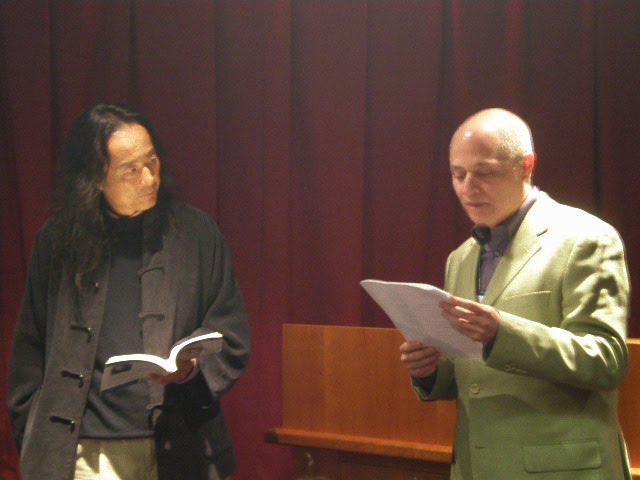

Yang Lian also performed a reading of imprisoned Nobel Peace Prize winner Liu Xiaobo's poem 'You Wait For Me With Dust'. As part of the Berlin Literatur Festival, readings of this poem were held all over the world on 20 March 2011 in celebration of his work, and to campaign for his freedom. You can also read the poem for yourself below:
You Wait for Me with Dust- for my wife, who waits every dayNothing remains in your name, nothingbut to wait for me, together with the dust of our homethose layersamassed, overflowing, in every corneryou’re unwilling to pull apart the curtainsand let the light disturb their stillnessover the bookshelf, the handwritten label is covered in duston the carpet the pattern inhales the dustwhen you are writing a letter to meand love that the nib’s tipped with dustmy eyes are stabbed with painyou sit there all day longnot daring to movefor fear that your footsteps will trample the dustyou try to control your breathingusing silence to write a story.At times like thisthe suffocating dustoffers the only loyaltyyour vision, breath and timepermeate the dustin the depth of your soulthe tomb inch by inch ispiled up from the feetreaching the chestreaching the throatyou know that the tombis your best resting placewaiting for me therewith no source of fear or alarmthis is why you prefer dustin the dark, in calm suffocationwaiting, waiting for meyou wait for me with dustrefusing the sunlight and movement of airjust let the dust bury you altogetherjust let yourself fall asleep in the dustuntil I returnand you come awakewiping the dust from your skin and your soul.What a miracle – back from the dead.April 9th 1999
Translated by Zheng Danyi, Shirley Lee and Martin Alexander
 |
Wednesday, 23 March 2011
Making Art with Htein Lin


Last Saturday Burmese artist Htein Lin joined TRIPWIRES to talk about his life, and experiences as a political prisoner in Burma. He described how his experiences in prison has directly affected his art, from the materials he uses, to how he paints and what he paints with.
The group then created their own art inspired by Htein Lin's talk. Click on the pictures to see some of their creations.


Tuesday, 22 March 2011
Poetics of Resistance

Date: Friday 25 March 2011, 7:30pm - 9:00pm
Where: Hitchcock Cinema, Arts Building, Queen Mary, Mile End Road, E1 4NS.
Click here for map of campus.
Produced by the Tripwires young trainees, The Poetics of Resistance is an evening of poetry reading and debate produced in partnership with Queen Mary University London’s (QMUL) School of Languages, Linguistics and Film. The evening will be chaired by Professor Omar Garcia.
Produced by the Tripwires young trainees, The Poetics of Resistance is an evening of poetry reading and debate produced in partnership with Queen Mary University London’s (QMUL) School of Languages, Linguistics and Film. The evening will be chaired by Professor Omar Garcia.
A selection of powerful poems reflecting on freedom of expression, oppression and resistance will be read and performed. An open dialogue will follow about how and why poets continue using their words inspite of oppression to express themselves, reflect on the world and inspire others.
Tripwires, delivered by Phakama (arts organisation in residency at QMUL) and Index on Censorship, uses the arts to create an open space where young people can explore and express their own lines on freedom of expression, self-censorship and offence.
If you would like to attend please RSVP to events@projectphakama.org by Thursday 24 March 2011, 5pm
Monday, 14 March 2011
Gurpreet Bhatti, Saturday 12th March 2011
This Saturday, British Sikh playwright Gurpreet Bhatti visited the Tripwires group to speak about her experiences as a writer. Her play, Behzti caused huge controversy when it was staged in Birmingham 2004, and eventually had to be cancelled due to protests from the local community. To this date, it has never been performed in the UK since.


(click on photos to enlarge)
Please see the video clip below for a glimpse into some of the discussion. The group also performed quick readings of some of the scenes.
Friday, 4 March 2011
TRIPWIRES on air in Birmingham

Members from TRIPWIRES were invited to be part of a radio debate in Birmingham. This is an excerpt of a blog by Hussina Raja about the day...
Throughout the debate we were given a number of questions and asked our opinions. Most of what we debated was similar to the discussions we have at TRIPWIRES. I found the debate kept making reference to religion, particularly Islam when discussing freedom of expression. It was insightful to get views from members of the audience, who were obviously passionate about their religious beliefs. The issue of religious and symbolic dress was brought up and the impact it has on being an influence on a person. We discussed the hijab and the banning of it in certain countries and came to the conclusion that media exposure combined with paranoia led to a sensationalised view that adopting such religious clothing could lead to extremism.
We touched on the presence and influence of Music in society today and how it is a powerful tool that gets people listening. With reference to Iran I understand that it’s not music as a whole that the Iranian government censors. Rock and Rap are banned genres of music in Iran depicted through stereotypes and negative media exposure as satanic and far too liberal for the traditional liking of the government. I came to understand that music creates fear because of how powerful it can be as a method of communication. How is it that I can listen to Nas when I was a youth and enjoy the rhythm but not understand the lyrics? Only now do I actually listen to the lyrics and not only make understanding of them but also relate to the music. Also how funny is it when your down in the dumps or going through a break up that you start to identify with certain music? That is the power of music; it generates emotional reactions and is influential to in some way to everyone.
"Music is so powerful because it attacks all the functions of the human being, the brain, the heart and the stomach...music is more powerful than words." - Daniel Barenboim (Pianist and conductor)
This made me realise how important it is to have something like TRIPWIRES, where we can debate issues of concern within a safe environment and from different perspectives. I think it would be exciting and rewarding to work with young people on a national basis so we can learn from each other. Seen as we have incredible technology which is taking over our basic forms of communication, we should utilise it to speak to other like minded individuals around the country..."
Saturday, 5 February 2011
Commedia Dell'Arte
Here's a few words from session leader Didi Hopkins about Commedia Dell'Arte and freedom of expression...
As part of the workshop, the group also had to try and act out what self-censorship felt like to them. See the clip below for some examples.
Commedia is a tool or key that unlocks some locked doors to creativity and freedom of expressionthere are rules and no rulesthere is nothing wrong and much right there is risk and courage and potential there is space to grow and explore and collaborate.
Commedia is about playing and responding working with not knowing, not planning, trusting and being free.
Commedia uses pictures and shapes in the body, sounds and actions to tell stories.Didi Hopkins' first company Beryl and the Perils was based on the perils of the famous comic book heroine as she rattled and railed against patriarchy and parents. The work was political and had many similarities to commedia dell'arte. So when Didi discovered Carlo Boso's style of commedia which came out of the piccolo theatre, milan, she realised it was a style she had a huge hunger for, and she went on to study, perform, research and direct commedia in europe and the UK. Didi is now one of the foremost teachers and directors of commedia in the UK where she brings the lightness of renaissance italy to meet the darker more tragic side of English Shakespeare to create compelling and extraordinary theatre.Commedia is an exaggerated style of theatre where characters are larger than life, stiller than life and at the same time more energetic than life, stories are extreme.Punch and Judy descended from Commedia. Tom and Jerry. Itchy and Scratchy.Commedia works like a comic book from frame to frame.Commedia is the DNA and grammar of European Theatre.Commedia is a tool or key that explores archetypes, types of people, types of behaviours.It is an oral tradition that has survived 500 years in the body.It is the root of comedy.It is irreverent satirical political - a mirror of society and very very tragic.Ha.Vive la Commedia.
As part of the workshop, the group also had to try and act out what self-censorship felt like to them. See the clip below for some examples.
What does self-censorship feel like? from Tripwires on Vimeo.
Saturday, 29 January 2011
Music...
Jack Pinter, musician and composer lead a session about music with TRIPWIRES. This is his account of the experience...
Jack Pinter has composed music for PBS television (U.S.) and for productions by The Royal National Theatre, Manchester Royal Exchange and Nottingham Playhouse, and many other theatre companies. He created and conducted an improvisational music project with the Easington Colliery Brass Band for the television documentary ‘Bloomin Human’, and wrote the music for The Learning and Skills Council documentary ‘Act Now.’
One of the most powerful and prevalent forms of censorship is the kind we place on ourselves. In the Tripwires session I led, we explored how we all often suppress our authentic, essential selves in order to meet others’ expectations, avoid our fears and protect that which is most precious within us. If we can eliminate, or even diminish, this self-censorship, we can allow our authentic selves to blossom and grow.I asked participants to draw two self-portraits: one as their unfettered, pure selves, and another as their censored selves—what they often present to the world. They then introduced these two selves to the group,and in doing so revealed the gap between who they truly are and the face they often show the world.Music is often one of the first things that attracts censorship. Why? The Chinese say that music is the one art form that goes directly to the soul, bypassing the filter of our brains. Words set to music have historically been the most powerful form of direct communication, and anthems for freedom or change have often been at the leading edge of transformation.Music has also historically been a way for oppressed people to communicate, using code and metaphor. Some of the greatest music of the 20th century—including jazz, blues and rock roll-sprang from oppressed people’s need to express their experience. And anyone can dothis, simply using the incredible expressive power of their own voices.
The Orange Tree Theatre in Richmond and The Marlowe Theatre in Canterbury have staged his musical adaptations of classics such as ‘The Pied Piper’, ‘The Sorcerer’s Apprentice’ and ‘Tales from the Arabian Nights.’ He has also created drama and music based education projects for orchestras and theatres including The Royal National Theatre, Glyndebourne Festival Opera, The London Philharmonic Orchestra, and the English Shakespeare Company.
Jack has done extensive recording and playing in orchestras, jazz and pop groups. This month he will be touring with actor turned singer Tim Robbins. Jack has played with Tom Waits, Marianne Faithfull, Anastacia, Dizzy Gillespie, and The Stereo MCs.
This is Jack’s first project with Phakama.
Monday, 10 January 2011
Speak Out Against Censorship
An early advertisement by Index on Censorship from 1986 starring Anthony Hopkins, depicting the importance of freedom of expression.
Tuesday, 14 December 2010
Belarus Free Theatre workshop
On Saturday 4 December 2010, the Belarus Free Theatre held a workshop with the Tripwires group.
This is participant Isobel Palmer's account of what went on...
It is sobering to discover that for some people, theatre is a matter of life or death. For the Belarus Free Theatre, that is literally the case. The Belarus Free Theatre were in London over the weekend to perform at a fundraising event held for supporters of free speech in Belarus at the Young Vic Theatre. The day before the event, we at Tripwires were lucky to receive a visit from them, alongside a screening of one of their short plays to be showcased the following day, ‘Numbers’.
In Belarus (‘the last dictatorship in Europe’) the Belarus Free Theatre are anything but ‘free’. They are illegal. All theatre in Belarus must be approved by the state, and as the Belarus Free Theatre do not obtain a permit, in the eyes of the Belarusian government, they do not exist. For the last three years they have performed anywhere from private apartments to abandoned industrial sites or in the forests. Often staged as parties, details of their performances can only be received by text message or on social networking sites posted at the last minute. When speaking to us, Natalia Koliada, co-founder of the Belarus Free Theatre, described their audiences in Belarus as the bravest audience in the world. They often come with their passports so, if arrested, they can be identified quicker.
We started the morning session with the Free Theatre showings us a video of their show, ‘Numbers’ (part three of their show ‘Zone of Silence’) directed by Vladimir Shcherban, performed in secret in a friend’s home (who knocked down their wall especially so that they had space to perform). The performance gave an insight into Belarus through data and statistics, revealing some stark truths on issues such as mental health, abortion, illness, employment and tax. These statistics are normally withheld from the public, but the Belarus Free Theatre spent over a year and a half gathering the information. As well as their powerful political message, what cannot be denied is also just how talented this theatre company is, ‘Numbers’ was a piece of gripping physical theatre. They embodied the data, bringing it to life with powerful urgency, through their bodies and live music.
Click on images from the session below to enlarge.


To find out more about Belarus Free Theatre please visit their official website at www.dramaturg.org
This is participant Isobel Palmer's account of what went on...
It is sobering to discover that for some people, theatre is a matter of life or death. For the Belarus Free Theatre, that is literally the case. The Belarus Free Theatre were in London over the weekend to perform at a fundraising event held for supporters of free speech in Belarus at the Young Vic Theatre. The day before the event, we at Tripwires were lucky to receive a visit from them, alongside a screening of one of their short plays to be showcased the following day, ‘Numbers’.
In Belarus (‘the last dictatorship in Europe’) the Belarus Free Theatre are anything but ‘free’. They are illegal. All theatre in Belarus must be approved by the state, and as the Belarus Free Theatre do not obtain a permit, in the eyes of the Belarusian government, they do not exist. For the last three years they have performed anywhere from private apartments to abandoned industrial sites or in the forests. Often staged as parties, details of their performances can only be received by text message or on social networking sites posted at the last minute. When speaking to us, Natalia Koliada, co-founder of the Belarus Free Theatre, described their audiences in Belarus as the bravest audience in the world. They often come with their passports so, if arrested, they can be identified quicker.
We started the morning session with the Free Theatre showings us a video of their show, ‘Numbers’ (part three of their show ‘Zone of Silence’) directed by Vladimir Shcherban, performed in secret in a friend’s home (who knocked down their wall especially so that they had space to perform). The performance gave an insight into Belarus through data and statistics, revealing some stark truths on issues such as mental health, abortion, illness, employment and tax. These statistics are normally withheld from the public, but the Belarus Free Theatre spent over a year and a half gathering the information. As well as their powerful political message, what cannot be denied is also just how talented this theatre company is, ‘Numbers’ was a piece of gripping physical theatre. They embodied the data, bringing it to life with powerful urgency, through their bodies and live music.
Click on images from the session below to enlarge.


For an interesting documentary on the Belarus Free Theatre by Al Jazeera, see this Youtube video:
Subscribe to:
Posts (Atom)